
This thermal-entrance (Graetz) problem has fully developed laminar flow in a plane channel. Heating begins at one location on an isothermal upper wall while the lower wall is insulated. Bulk temperature approaches wall temperature and local Nusselt number falls toward the fully developed limit Nu = 4.861 (Shah and London, 1978). It checks Boreas's isothermal-wall heat transfer, formula-defined inlet velocity, heat balance, and temperature-advection convergence. Results are from Boreas v0.10.0 on GPU; CPU was used only to diagnose the coarsest mesh.
The benchmark is a high-resolution solution of the two-dimensional steady energy equation with the same domain and boundary conditions. Its downstream Nusselt number agrees with the classical Graetz limit, Nu = 4.861. Errors below compare two numerical solutions; they are not discrepancies from an experiment.
Model and boundary conditions
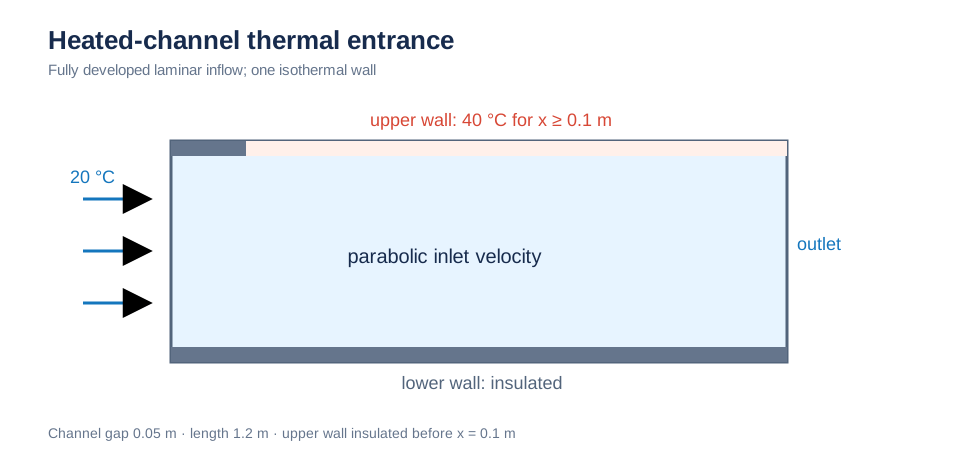
Fully developed laminar flow enters at 20 °C. The upper wall is held at 40 °C from x = 0.1 m onward; the lower wall and upstream upper wall are insulated. Schematic; not to scale.
Reference solution
For prescribed velocity u(y) = 6U_m(y/a)(1 − y/a), the steady energy equation is:
The reference solves this equation with the Boreas domain and boundary conditions: inlet-face T_in, zero-gradient outlet, upper-wall T_w for x ≥ X0, and insulated lower wall. Cell-centered finite volumes and central differences on 1920 × 160 and 3840 × 320 meshes are Richardson-extrapolated; their maximum difference is 5.4e-3 K. A classical Graetz solution without axial conduction independently gives downstream Nu_Dh = 4.8607 (published 4.861). Axial conduction raises dimensionless bulk temperature θ by about 1.5e-3, so the two-dimensional solution including it is the proper Boreas reference.
Bulk temperature and interval-average Nusselt number are defined below, with D_h = 2a. The same interval estimator is applied to the reference solution.
Simulation setup
| Item | Boreas setting |
|---|---|
| Channel | Gap a = 0.05 m, length L = 1.2 m, two-dimensional slab |
| Inlet | Fully developed u = 6U_m(y/a)(1 − y/a) prescribed by a spatial formula; U_m = 0.03 m/s; T_in = 20 °C |
| Walls | Upper wall at 40 °C for x ≥ 0.1 m (first 0.1 m insulated), lower wall insulated; pressure outlet |
| Air | ρ = 1.2 kg/m³, c_p = 1005 J/(kg·K), ν = 1.5e-5 m²/s, α = 2.376e-5 m²/s; Re_Dh = 200, Pe_Dh = 126 |
| Mesh | Uniform h = a/N, N = 8, 16, 32, 64 (up to 295,000 cells) |
| Time | dt = 0.25 s, 400 s total; residence time 40 s, transverse diffusion time a²/α = 105 s |
| Advection | Semi-Lagrangian and upwind |
| Comparison | Bulk temperature at planes spaced 0.05 m apart (RMS θ error), interval-average Nu_Dh, outlet heat balance |
Bulk temperature and Nusselt number
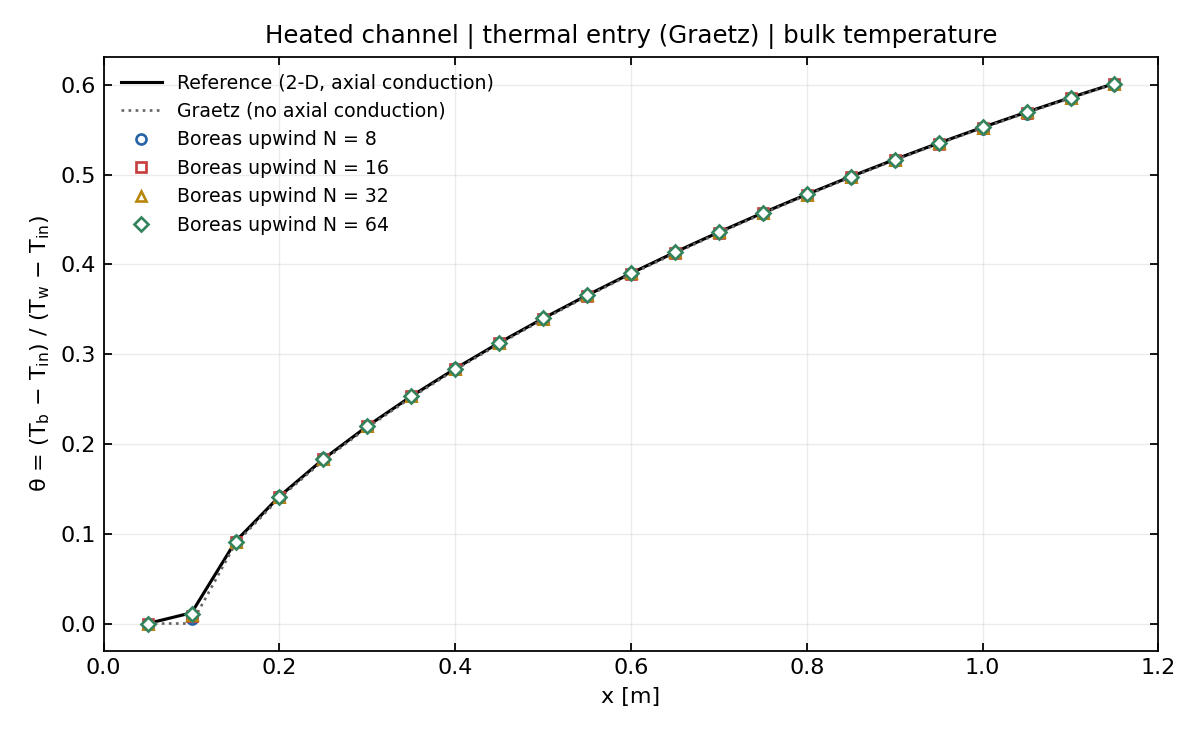
Upwind bulk temperatures on four meshes (markers), the two-dimensional reference (solid line), and Graetz without axial conduction (gray dashed line). θ rises from the heating start at x = 0.1 m.
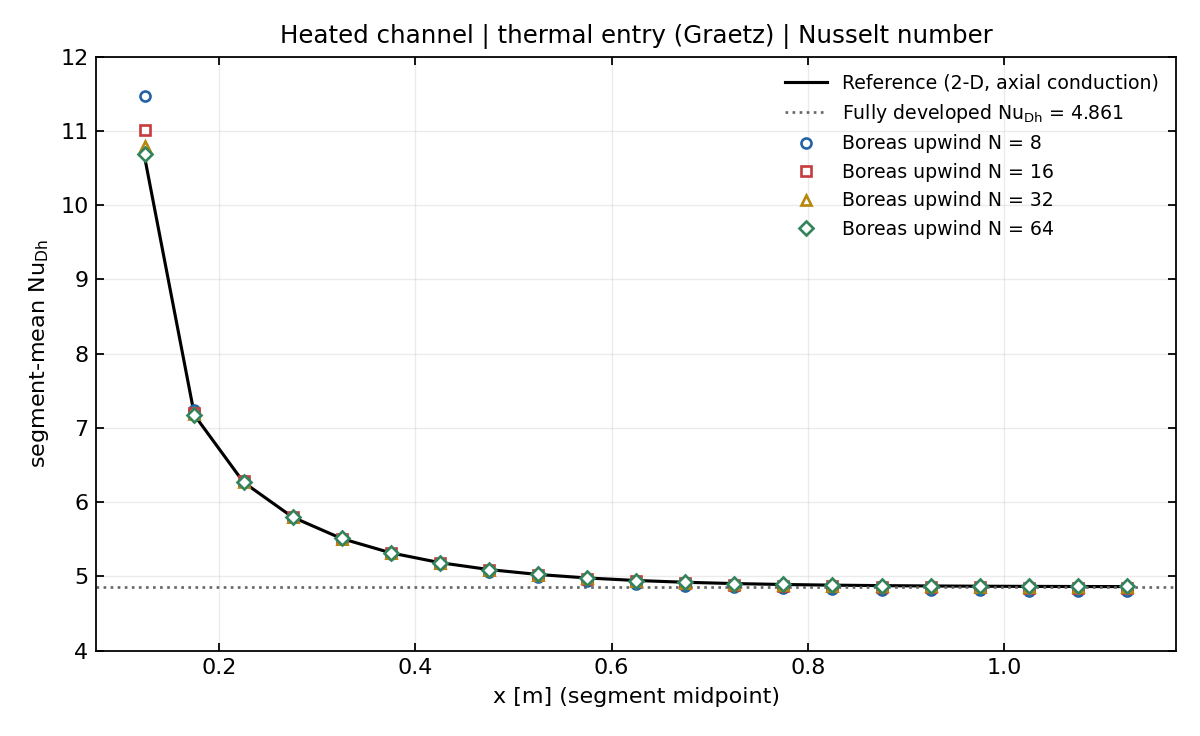
Nu_Dh falls from a high entrance value toward 4.861. The first heated interval, x = 0.10–0.15 m, contains the heating-start singularity and has larger coarse-mesh differences.
Mesh convergence
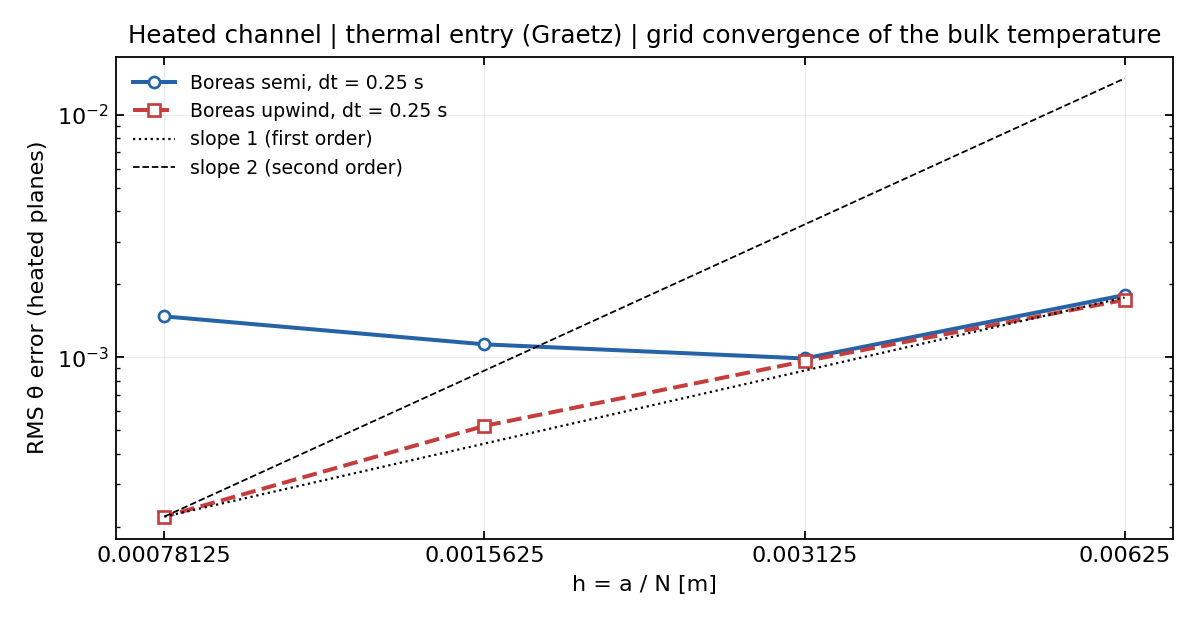
RMS θ error on heated-section planes. Upwind follows the first-order dashed guide. Semi-Lagrangian ceases improving beyond N = 16 with dt fixed at 0.25 s.
| N | Upwind θ RMS | Upwind Nu error, x ≥ 0.5 m [%] | Upwind heat imbalance [%] | Semi θ RMS | Semi Nu error [%] | Semi heat imbalance [%] |
|---|---|---|---|---|---|---|
| 8 | 1.73e-3 | −1.02 | 0.00 | 1.81e-3 | −1.16 | −0.08 |
| 16 | 9.64e-4 | −0.30 | 0.01 | 9.90e-4 | −0.53 | −0.11 |
| 32 | 5.22e-4 | −0.10 | 0.01 | 1.13e-3 | −0.38 | −0.11 |
| 64 | 2.21e-4 | +0.01 | −0.04 | 1.48e-3 | −0.37 | −0.10 |
Halving h reduces upwind error by a factor of 1.8–2.4, consistent with first-order streamwise upwind differencing. At N = 64, downstream Nu is 4.863 versus reference 4.861. Conservative discretization closes the heat balance within 0.04%.
Transient history
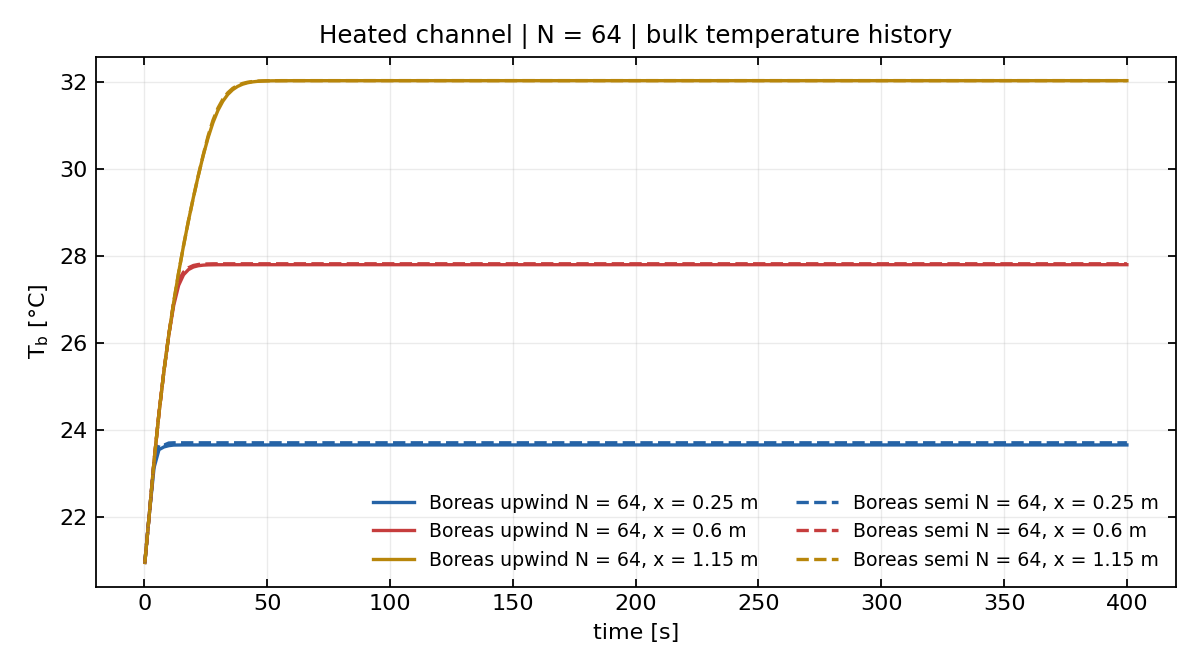
Bulk temperatures at x = 0.25, 0.6, and 1.15 m (solid upwind, dashed semi-Lagrangian). They settle within 50 s and remain steady through 400 s.
Quantitative results
| Metric | Value |
|---|---|
| Downstream Nu_Dh, upwind N = 64 (reference 4.861) | 4.863 |
| Downstream Nu error, upwind N = 64 [%] | +0.01 |
| θ RMS error, upwind N = 8 → 64 | 1.73e-3 → 2.21e-4 |
| Upwind heat-balance imbalance [%] | ≤ 0.04 |
| Upwind mesh convergence order | 1 |
Interpretation and limits
- Semi-Lagrangian convergence stalls at high CFL. At dt = 0.25 s and N = 64, maximum CFL is about 14 and θ RMS stays near 1e-3 as the mesh is refined. Reducing dt to 0.05 s (CFL 2.9) on the same deck gives θ RMS 1.25e-4, better than upwind. A mesh ladder alone cannot establish semi-Lagrangian accuracy when CFL grows.
- v0.10.0 outlet temperature-boundary defect. Specifying a reverse-flow
temperatureon a pressure outlet also applies temperature Dirichlet to outward-flow faces in v0.10.0, conducting heat out of the outlet. In the initial run, outlet mass-average temperature was 3 K below the preceding plane and heat imbalance reached 25%. All results here omit that key; the defect was fixed in v0.10.1. - Inlet/heated-wall corner. Starting heating at x = 0 lets conductive heat leave backward through the inlet face without entering the heat-balance monitor. Its imbalance grew from 1.5% to 4.3% with refinement. Heating therefore starts at x = 0.1 m.