
How a lamp is modeled has a major effect on the accuracy of a UV fluence calculation. UVSim3D adopts MSSS (Multiple Segment Source Summation), proposed by Bolton (2003), as its default model, and also supports MPSS (Multiple Point Source Summation) as an alternative. This document summarizes how both models validate against experimental data published in the literature.
Model overview
At wavelengths below 300 nm, absorption dominates the medium's behavior and scattering/emission are nearly negligible, so the radiative transfer equation (RTE) simplifies to:
Integrating this gives the Beer-Lambert law, a special solution for an absorption-dominant medium:
A lamp's contribution is then computed by combining this with refraction at the lamp → quartz sleeve → water interfaces (Snell's law), reflection (Fresnel's law), and distance-based attenuation (the inverse square law). The two models differ in how the lamp itself is represented as a light source.
- MPSS: models the lamp as the sum of several discrete point sources. Simple to compute, but tends to be inaccurate near the lamp and at its ends.
- MSSS: models the lamp as a segment (line) source, which represents refraction and reflection more realistically. It has been recognized as a validated standard model in UV reactor design for over 20 years.
Case 1: Single lamp in air
Reference: Liu, D., et al. "Evaluation of alternative fluence rate distribution models." Journal of Water Supply: Research and Technology—Aqua, 2004, 53.6: 391-408.
Test condition: Fluence Rate measured at 5 cm, 10 cm, and 15 cm from the lamp center.
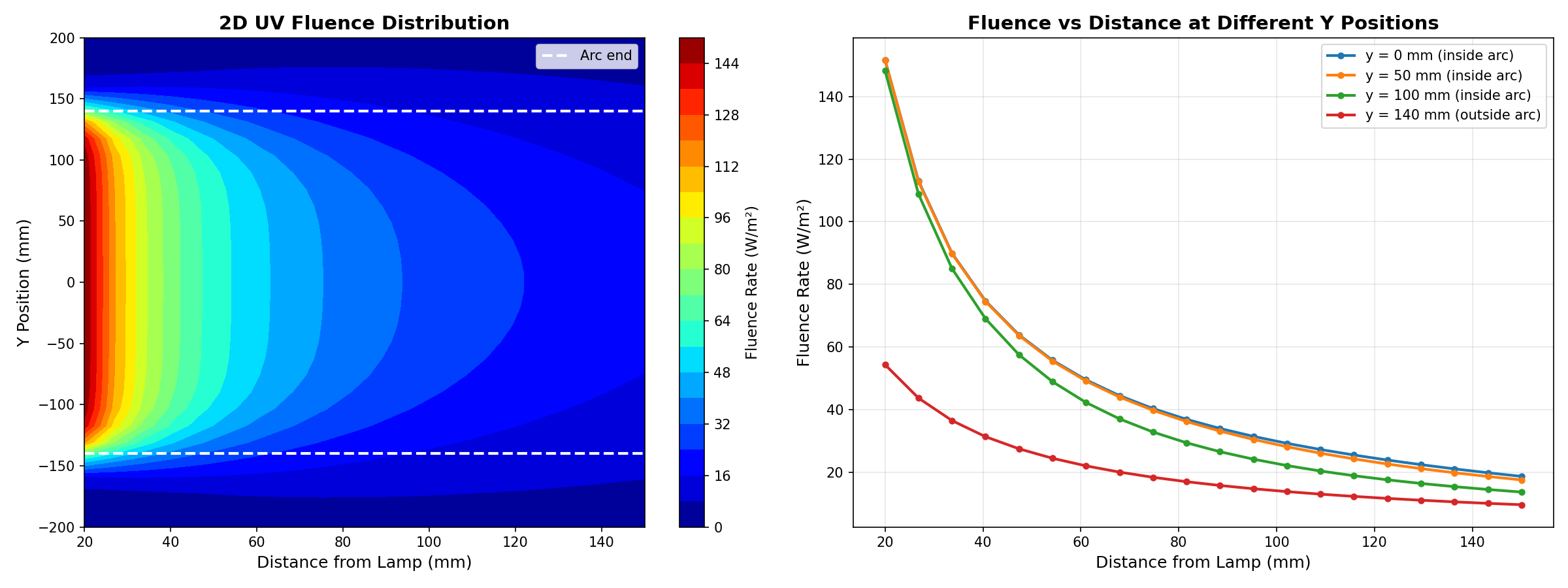
Left: 2D UV fluence distribution (arc region marked). Right: fluence rate attenuation vs. distance at different Y positions (inside/outside the arc)
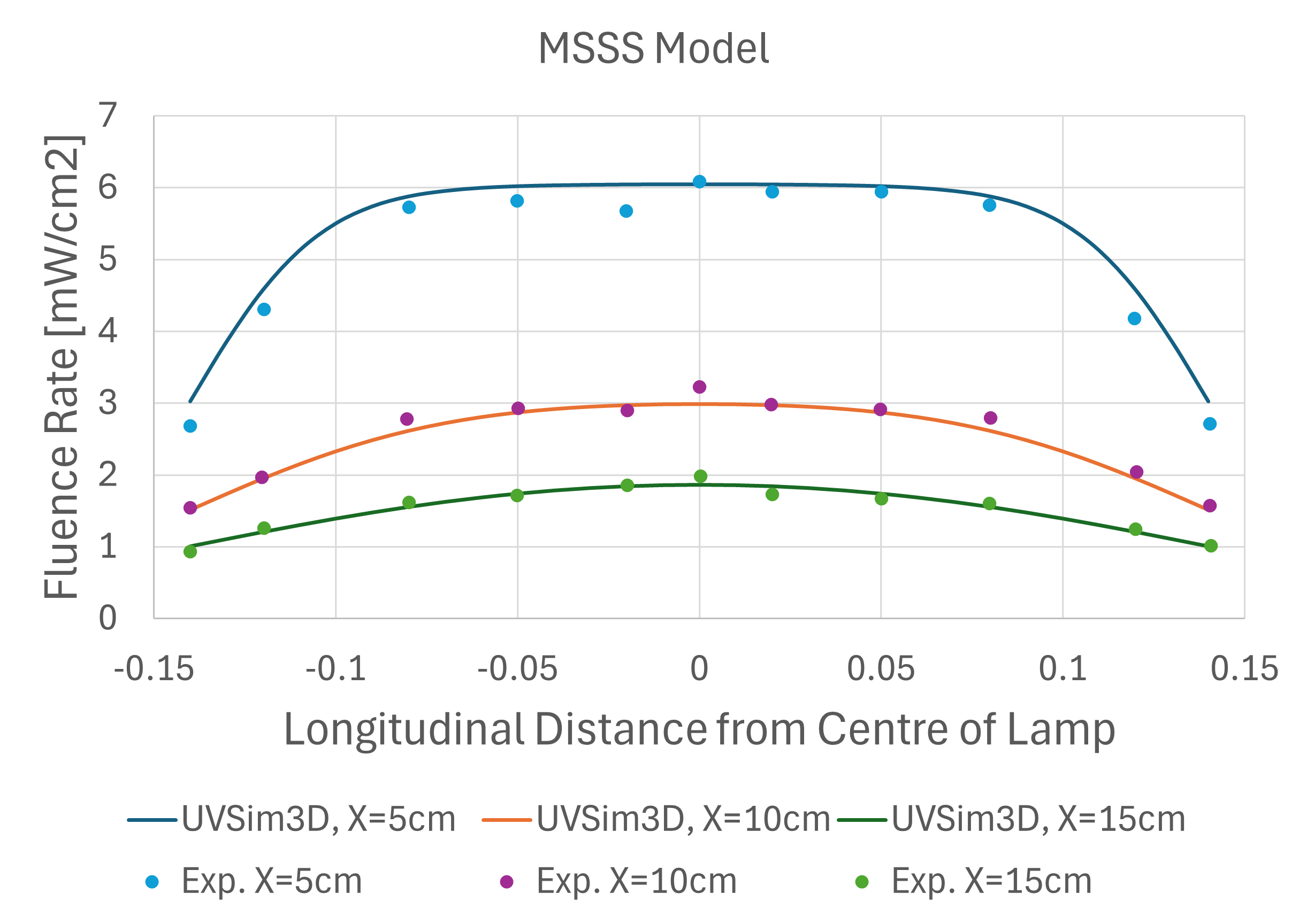
MSSS model (solid lines) — matches experimental values (points) well at all distances (X=5/10/15cm), including near the lamp ends (curve endpoints)
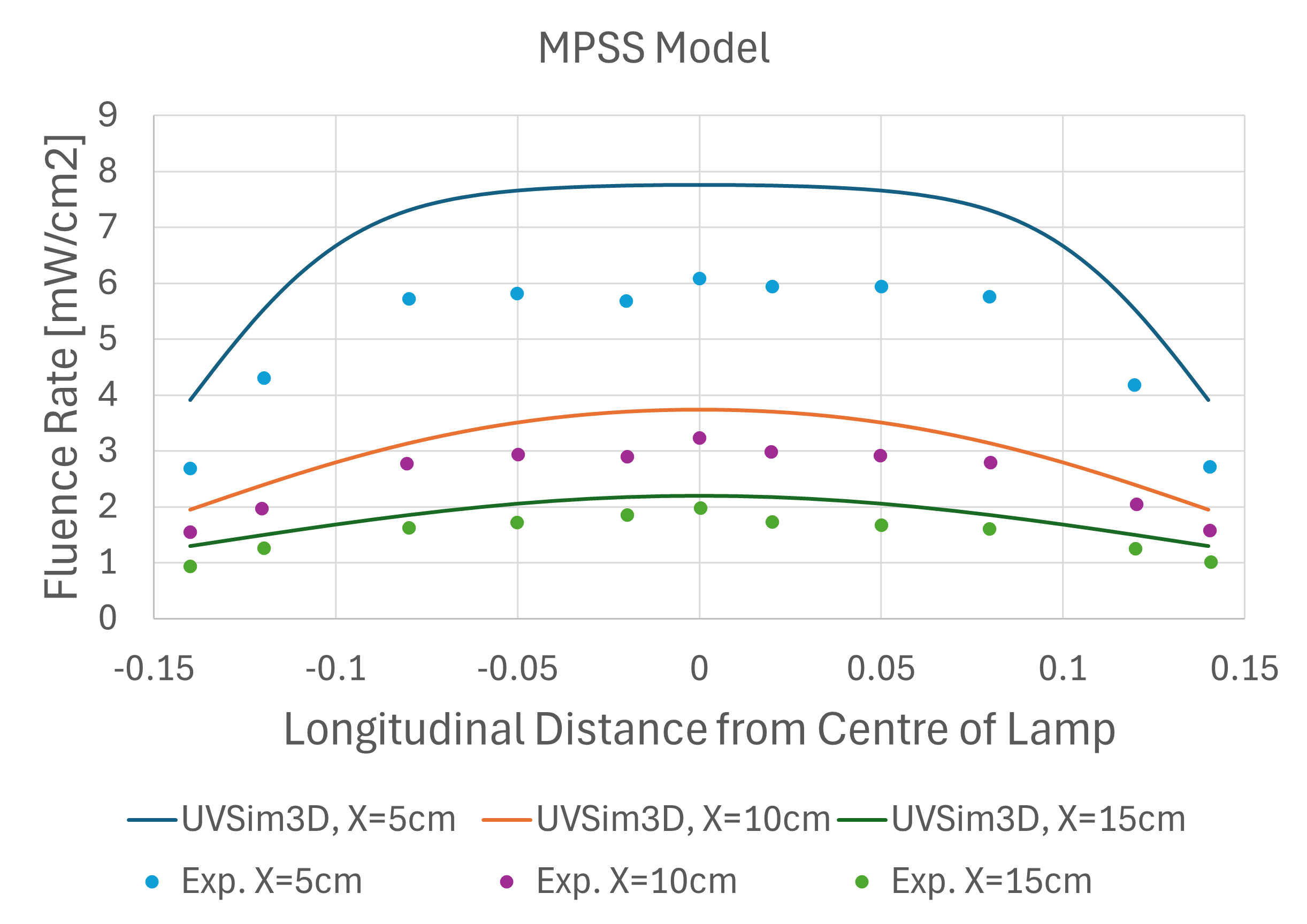
MPSS model (solid lines) — noticeably over-predicts at the center for X=5cm, the distance closest to the lamp
Result: MSSS matches the experimental values well both radially and axially, including near the lamp ends. MPSS, on the other hand, over-predicts the center-line fluence rate at X=5cm — about 7.7 mW/cm² against an experimental value of roughly 6.1 mW/cm² — clearly showing the limits of the point-source approximation.
Case 2: UV disinfection pilot reactor
Reference: Wols, B.A., et al. "Comparison of CFD, Biodosimetry and Lagrangian Actinometry to assess UV reactor performance." Delft University of Technology, 2012.
Test condition: 4 low-pressure UV lamps (Hereaus NNI125 84KL); fluence rate distribution measured across the reactor cross-section at three water UV transmittance (UVT) levels — 72.5%, 79%, and 87%.
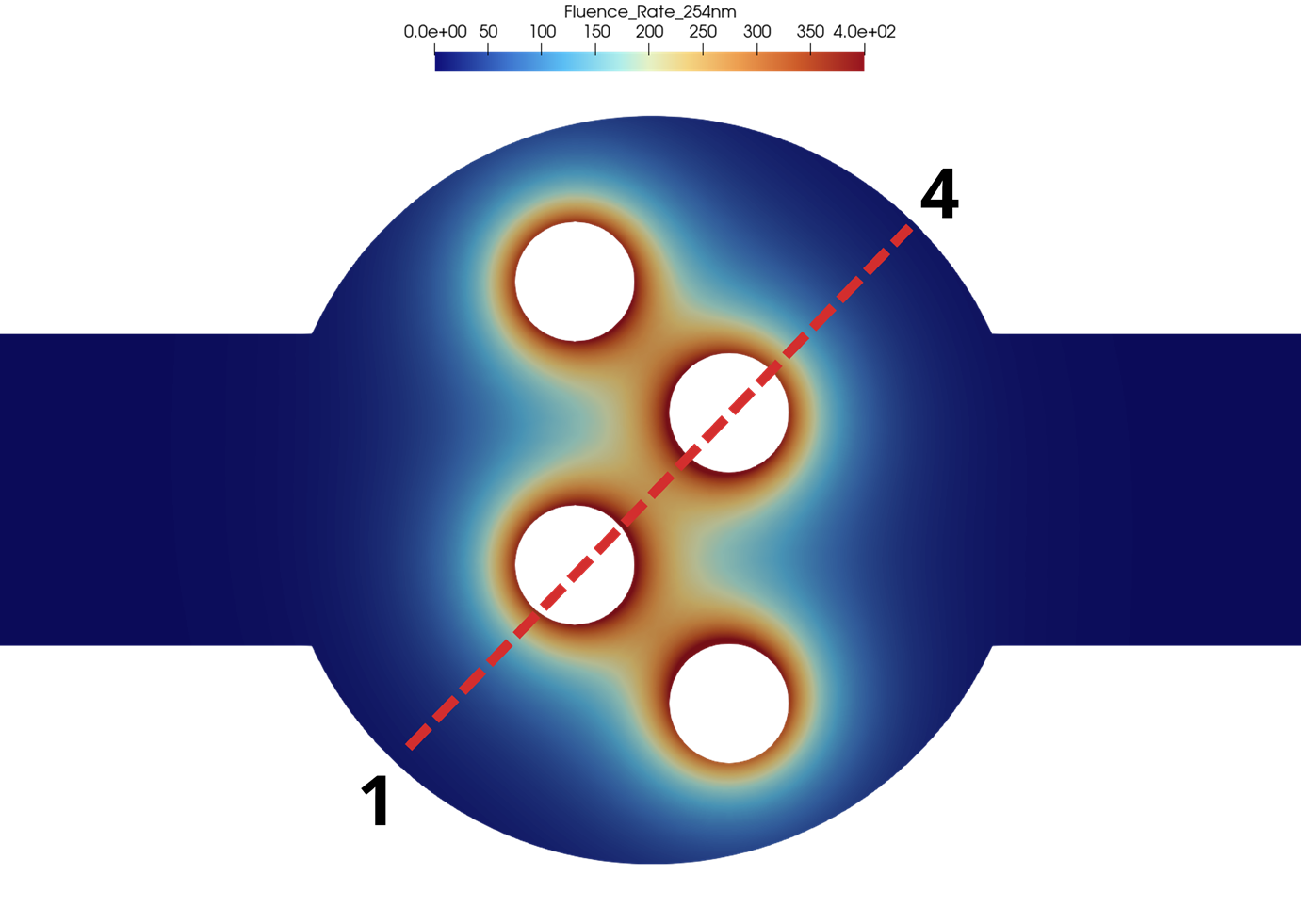
Cross-section of the 4 lamps (white circles) and the measurement line (1→4). Fluence rate rises locally where adjacent lamps overlap
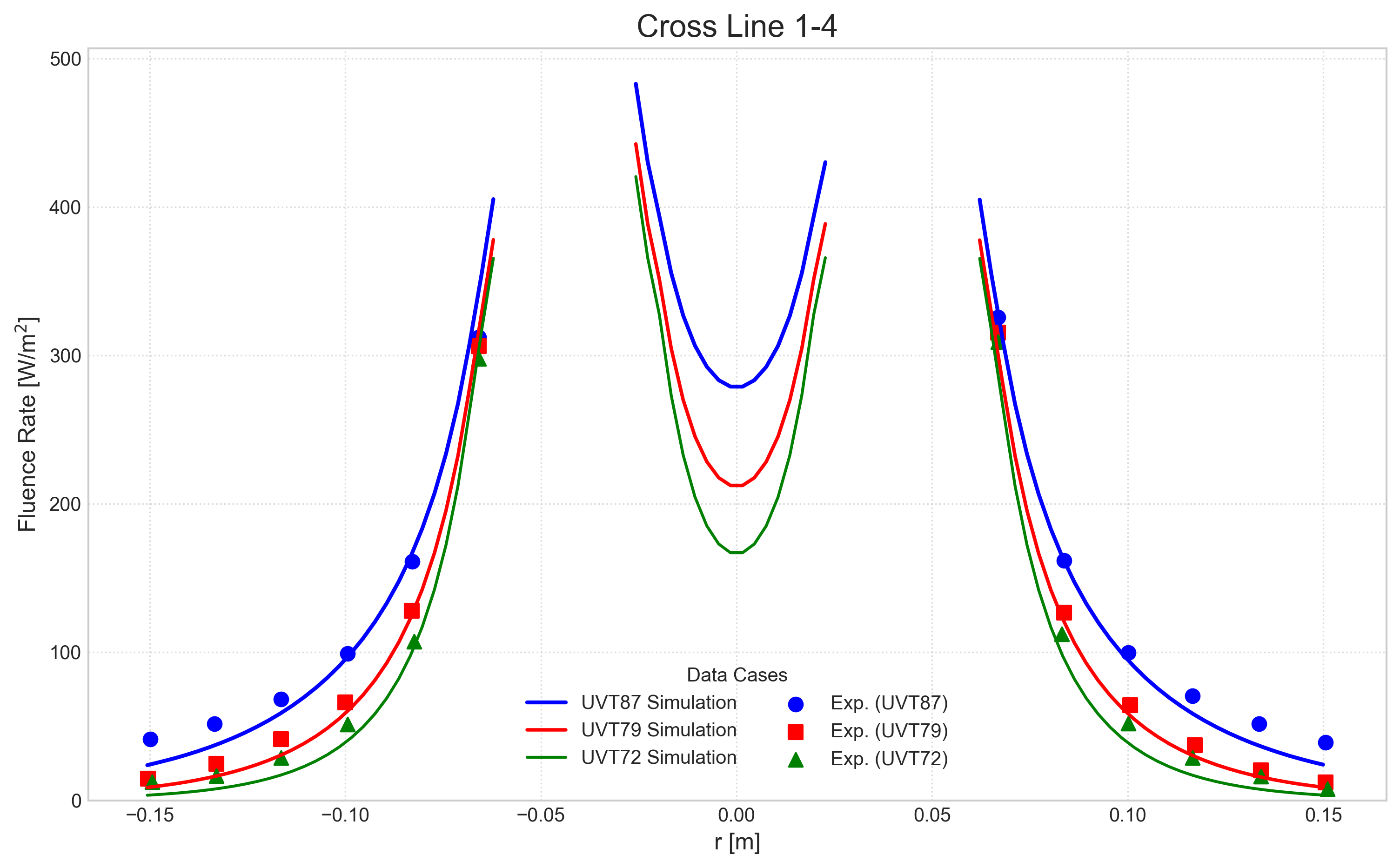
At all three UVT conditions (72/79/87%), the MSSS simulation (solid lines) tracks the experimental values (circles/squares/triangles) closely
Result: including the pattern of elevated fluence rate at the reactor center from overlapping adjacent lamps, all three UVT conditions were reproduced within an average error of 5% or less versus experiment. The attenuation effect from differing UVT levels is also predicted reliably.
Case 3: VUV/UV photoreactor (185 / 254 nm)
254 nm is used mainly for disinfection, while 185 nm breaks water molecule (H₂O) bonds to generate hydroxyl radicals (•OH) for photochemical reactions (e.g. UPW oxidation processes). We computed the fluence rate distribution at both wavelengths for an actual reactor geometry with a 24-lamp array.
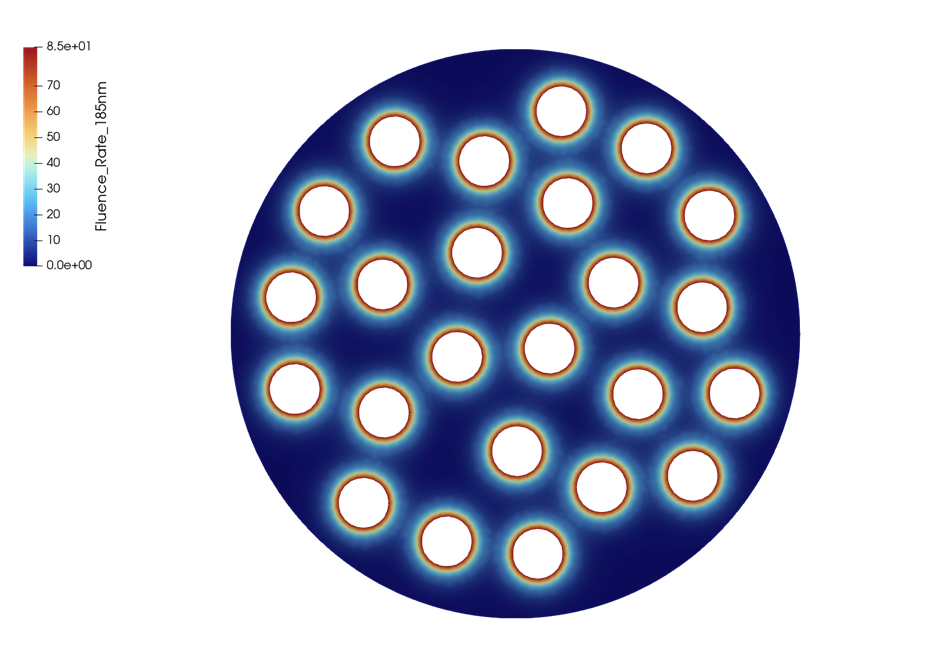
185nm — the wavelength band involved in photochemical reactions (radical generation)
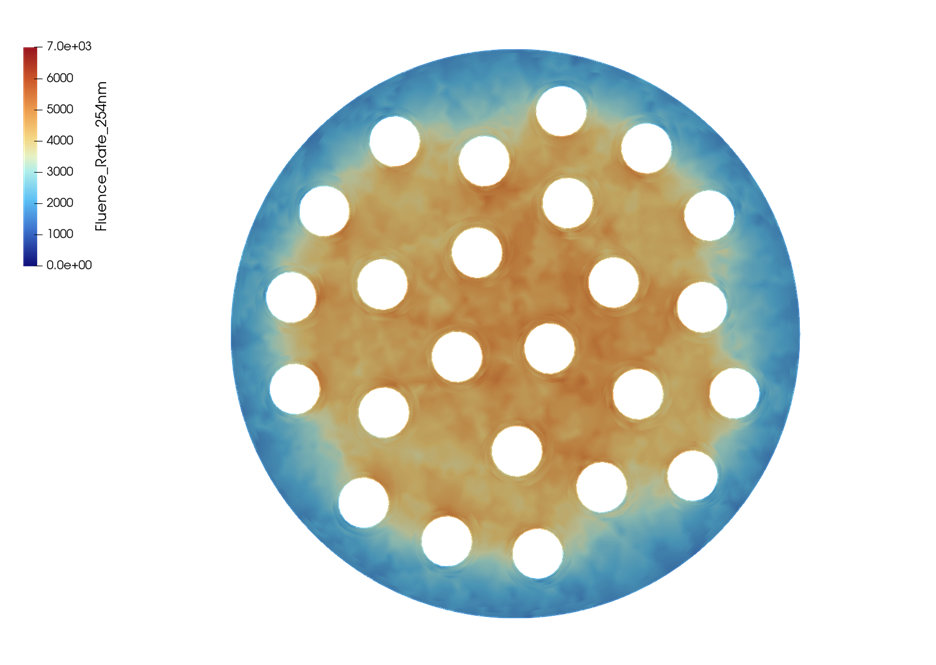
254nm — the wavelength band mainly responsible for disinfection. Fluence rate rises sharply in the high lamp-density center
Public experimental data at 185 nm is scarce, due to the health hazards and high cost of such measurements, so a quantitative comparison against literature like Cases 1 and 2 isn't feasible here. Treat this case not as quantitative validation, but as an example of UVSim3D's calculation capability for a multi-wavelength, multi-lamp reactor geometry.
Conclusion
- Beer-Lambert-based MSSS provides sufficient accuracy (average error of 5% or less against literature) for the design stage of absorption-dominant UV reactors, while running roughly 10-15x faster than RTE-based models.
- MPSS tends to over-predict near the lamp and at its ends, so it's recommended only as a reference; MSSS should be the default for actual design and optimization work.
- Further reading: MSSS 모델을 활용한 자외선 방사 시뮬레이션 - 상세 분석 (CLEW blog, Korean)