
This document validates whether UVSim3D's DOM (Discrete Ordinates Method) model correctly solves the radiative transfer equation, using standard benchmark cases from the radiative heat transfer literature.
Model overview
DOM solves the radiative transfer equation (RTE) over a finite set of discrete directions. In a medium with absorption, emission, and scattering, the radiative intensity along direction satisfies:
where is the absorption coefficient, is the scattering coefficient, and is the blackbody intensity of the medium. The quantity of interest, fluence rate , is the integral over all directions:
For UV reactor analysis, scattering by water is negligible and thermal emission at UV wavelengths at room temperature is insignificant, so and , reducing the equation to a pure attenuation problem. Attenuation through a homogeneous medium then follows the Beer-Lambert law:
Validation cases
We used two of the three cases presented by Fiveland (1984): one dominated by absorption, and one driven purely by scattering. Each isolates a different term of the equation for validation.
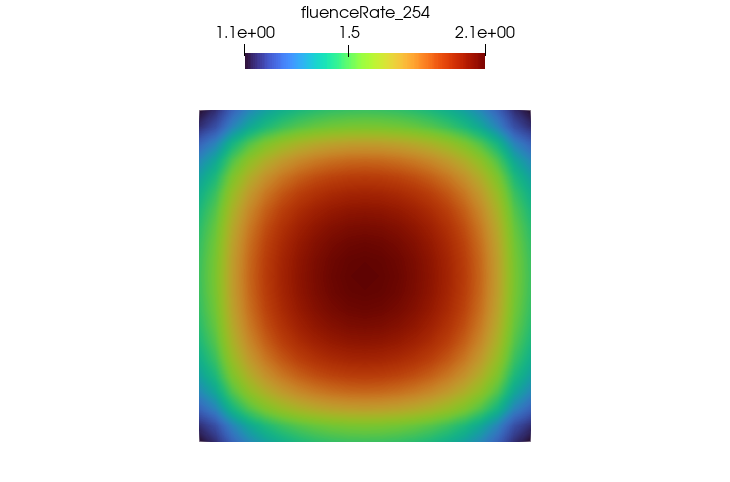
Example fluence rate distribution for Case A — since all four walls absorb fully, the value peaks at the center and falls off symmetrically toward the corners
Case A — blackbody enclosure filled with an absorbing medium
- Square enclosure, all four walls cold and black (emissivity 1, no emission)
- Interior is a purely absorbing medium emitting at unit blackbody intensity $E_b = 1$, with no scattering
- Absorption coefficient = 0.1, 1.0, 10.0 m⁻¹ — sweeping optical thickness over a 100x range
- The compared quantity is the dimensionless wall radiative heat flux
Case B — purely scattering medium
- Square enclosure, one wall hot (unit blackbody intensity), the other three cold
- Purely scattering medium with , no absorption ( )
- Wall emissivity = 1.0, 0.5, 0.1 — since the walls are opaque and gray, reflectivity is
- The compared quantity is the net heat transfer rate leaving the hot wall
Since there is no absorption at all, all energy emitted by the hot wall must reach the other walls. This isn't an approximation but an identity, letting us directly verify that the scattering term neither creates nor destroys energy.
The original problem is 2D (an infinitely long duct). Since UVSim3D is a 3D solver, we reproduced the infinite duct by applying symmetry boundaries on both faces of a single-cell-thick mesh. A solution uniform through the thickness direction automatically satisfies the specular-reflection condition at both symmetry planes, so this is an exact reproduction, not an approximation. The mesh uses the same 20 divisions per side as the paper.
Result 1 — absorbing medium, wall heat flux distribution
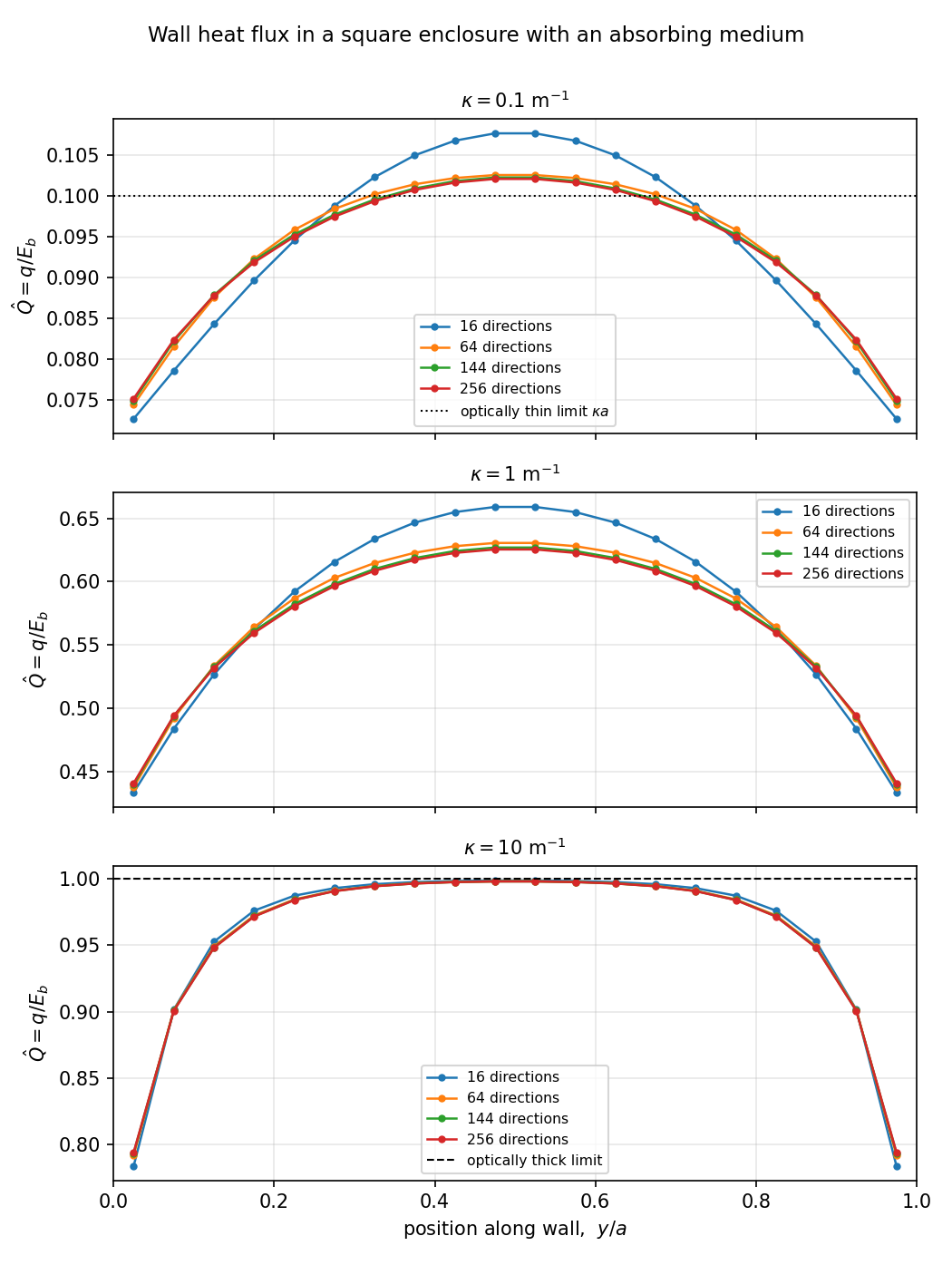
At all three optical thicknesses, the distribution is symmetric with a maximum at the wall center and a minimum at the corners, and the value range matches the results reported in the paper. Increasing the number of discrete directions from 16 to 256 gives monotonic convergence, with the difference between 144 and 256 directions under 0.3%.
With too few directions (16), the value at the wall center tends to be overpredicted — a known characteristic of DOM, and the paper itself notes that the lowest-order approximation isn't recommended for absorption-dominated problems.
Result 2 — purely scattering medium
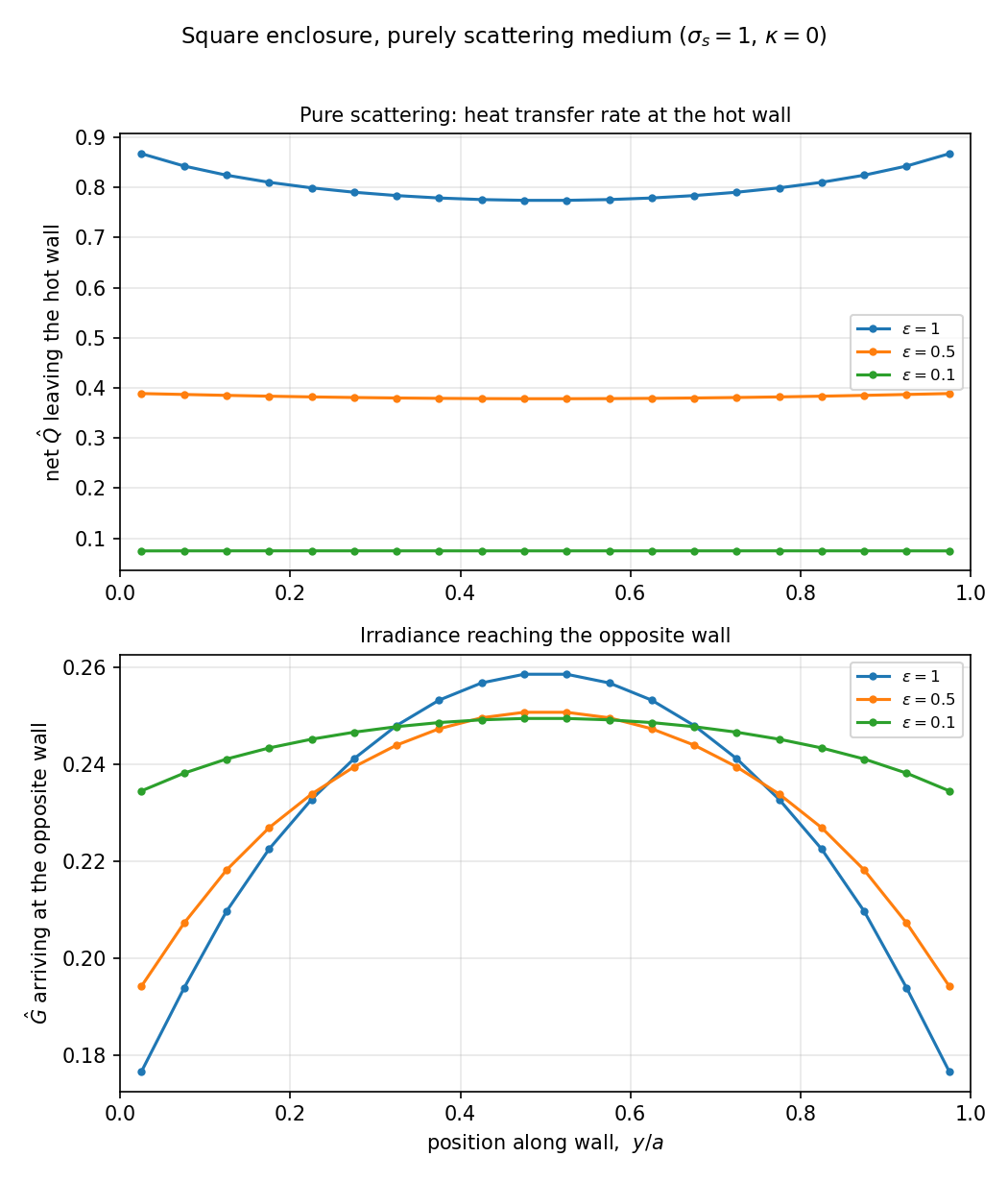
The net heat transfer rate leaving the hot wall matches the literature results at all three emissivities.
- : 0.774 – 0.867 (literature approx. 0.78 – 0.85)
- : 0.379 – 0.389 (literature approx. 0.38 – 0.40)
- : 0.0750 – 0.0751 (literature approx. 0.07 – 0.08)
As emissivity decreases, the distribution flattens, consistent with the literature trend — a more reflective enclosure homogenizes the radiative field.
The energy side of the result is even more definitive. The radiative energy emitted by the wall matched exactly ( 0.0500 / 0.0250 / 0.0050 W for = 1.0 / 0.5 / 0.1 respectively), medium absorption was exactly 0, and the rest reached the walls in full. The energy balance error is 0.00% in all three cases — confirming that scattering redistributes radiation without creating or destroying it.
The scattering case required 128 iterations to converge (versus 14 for the absorption-only case), because scattering couples the discrete directions together — this is the expected behavior.
Result 3 — comparison against analytical limits
Matching the range of values on a graph is a weak form of validation. The two limits below have known analytical solutions, allowing a quantitative comparison.
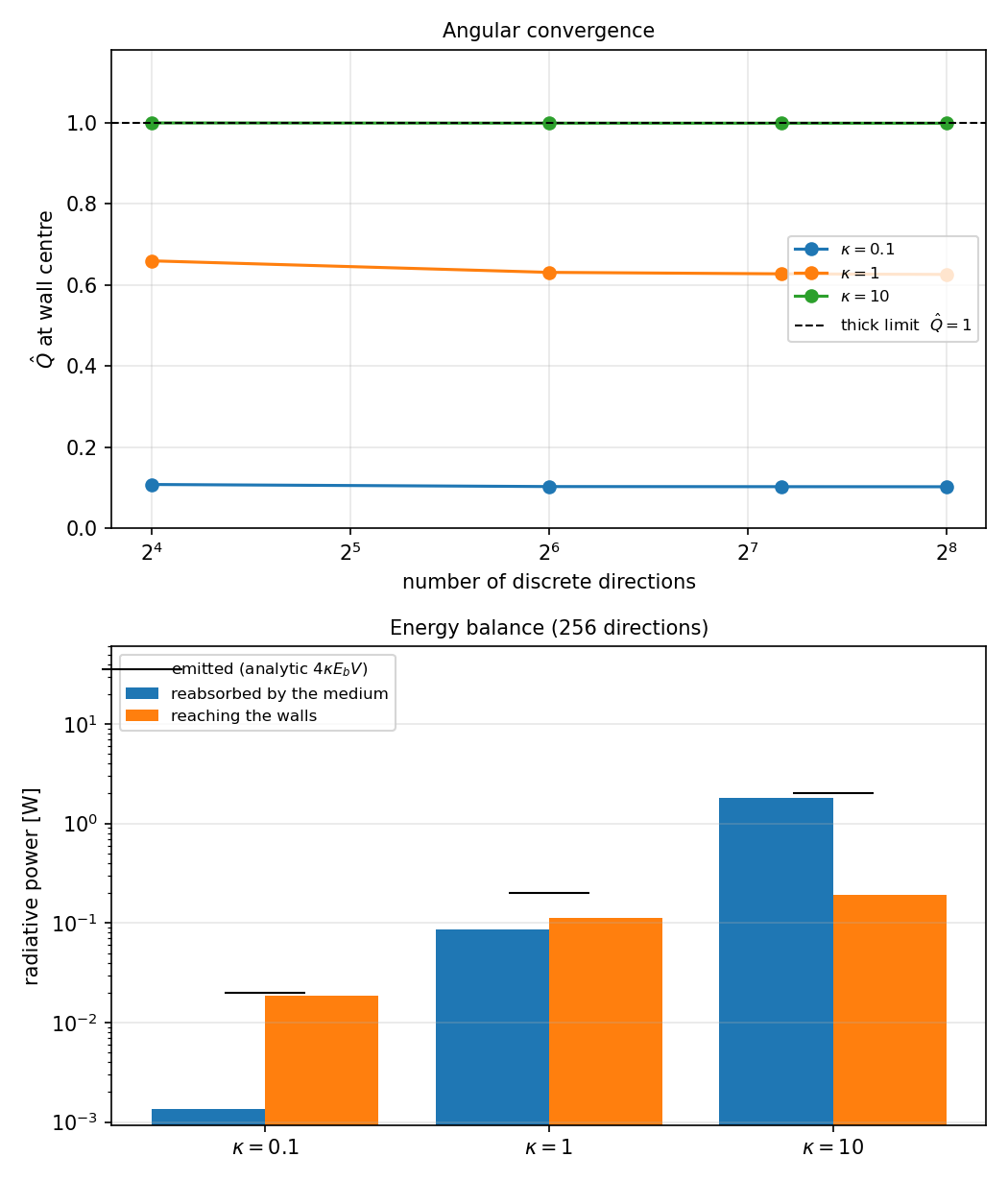
Optically thick limit. As grows large enough, the wall effectively faces a blackbody, so . At , the computed value at the wall center is 0.9982, a 0.18% difference from the theoretical value.
Optically thin limit. As becomes small, radiation emitted by the medium is not reabsorbed and reaches the walls in full, so the average wall heat flux converges to ( where is the side length ). At , the computed value is 0.0933 against a theoretical value of 0.1 — but this gap isn't error. The same calculation shows the medium reabsorbed 6.7% of its own emission, and 0.0933 is exactly 93.3% of 0.1. In other words, the shortfall exactly matches the reabsorbed amount.
Energy balance. The total radiative energy emitted by the medium must either be reabsorbed by the medium or reach the walls. This balance holds under every tested condition (0.00% error), and the total emission also matches the analytical value exactly — further confirming that the symmetry boundaries neither create nor destroy energy.
Conclusion
- The wall heat flux distribution in the absorbing medium matches literature results across the full 0.1 – 10 optical thickness range, and converges monotonically with the number of discrete directions.
- The purely scattering medium also matches literature results across the full 0.1 – 1.0 emissivity range.
- At the two limits where analytical solutions exist, the error is 0.18% (thick limit) and fully explained by the reabsorbed fraction (thin limit).
- Energy conservation holds under every condition (0.00% error).
These results confirm that the DOM model correctly discretizes the radiative transfer equation.
References
- Fiveland, W. A. (1984). Discrete-Ordinates Solutions of the Radiative Transport Equation for Rectangular Enclosures. Journal of Heat Transfer, 106(4), 699-706.
- Chai, J. C., Lee, H. S., & Patankar, S. V. (1993). Ray Effect and False Scattering in the Discrete Ordinates Method. Numerical Heat Transfer, Part B, 24(4), 373-389.