
UVSim3D's DOM model checked against a problem whose exact answer is known, to establish that it solves the radiative transfer equation correctly. The literature benchmark with absorption, scattering and emission all present is covered in the enclosure validation; this document takes the case with no absorption at all — pure propagation.
Comparing against measurement mixes two questions together: is the model right and is the solver right. Setting aside a problem with a known exact answer separates them, which is what makes it possible to say where a discrepancy against measurement belongs.
An energy balance cannot establish this
The first check that comes to mind is the energy budget, and it will not do. The transport calculation and the energy ledger share the same intensities, so a self-consistent error closes the ledger just as neatly as a correct answer does. A balance closing to 0.00 % is necessary, not sufficient.
What is needed is a reference the solver derives nothing from.
The problem
Making both ends of the domain symmetry planes and letting the whole inner cylinder emit turns
it into an infinitely long diffuse cylinder. In a non-absorbing medium radiance is invariant
along a ray, so every ray arriving from the cylinder carries the same radiance L = q/π, and the
fluence rate depends only on the solid angle the cylinder subtends.
where is the cylinder radius and its surface emissive power. It follows from an infinite cylinder of radius subtending exactly steradians at distance .
This expression comes from radiance invariance and a solid angle alone — no discretisation, no sweep, no grid. Agreement is therefore independent evidence rather than a restatement.
At it gives , the standard result just outside a Lambertian surface. W/m² is arbitrary; the problem is linear.
Results
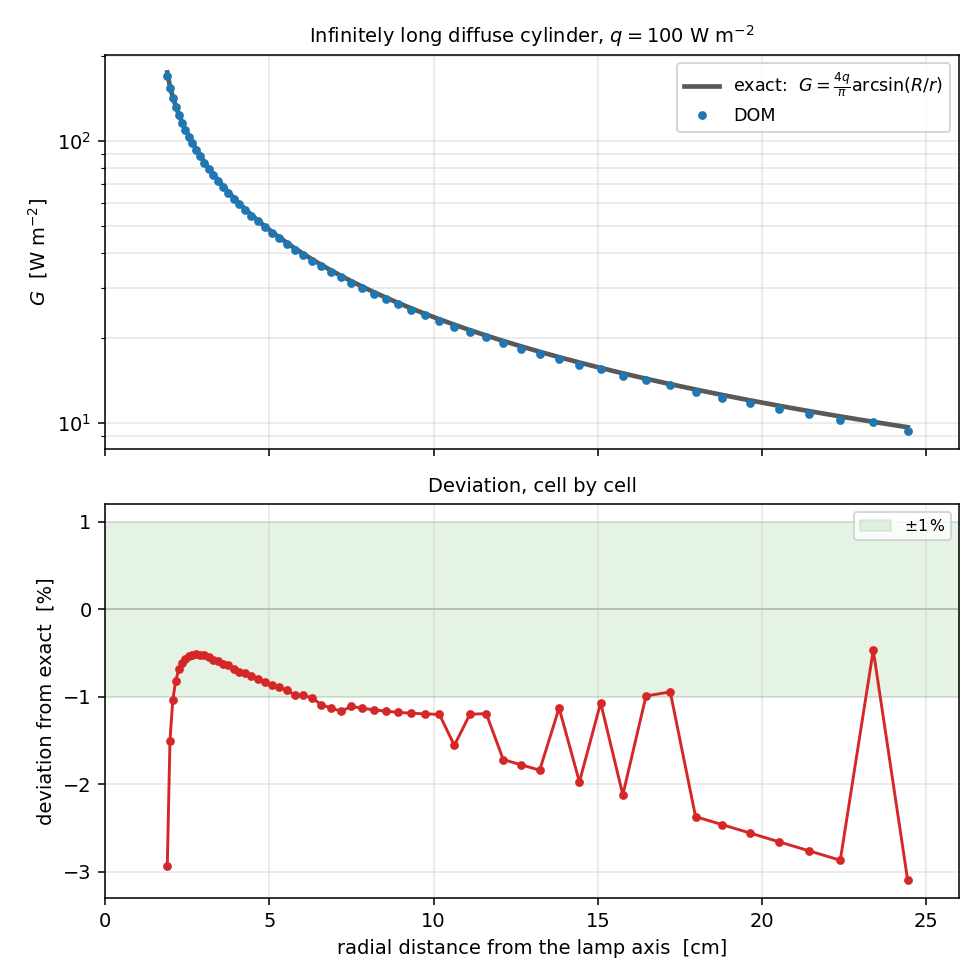
| Deviation | |
|---|---|
| Innermost cell | 2.94 % |
| Everywhere beyond it, maximum | 3.10 % |
| Everywhere beyond it, mean | 1.12 % |
| Axial variation | exactly 0 |
The 3 % in the innermost cell is a first-order scheme flattening a gradient across a cell over which the fluence rate falls by 8 %; it shrinks as the grid is refined.
Axial variation being exactly zero is a separate confirmation — the symmetry boundaries reproduce an infinite cylinder exactly rather than approximately. Every discrete direction has its mirror image in the same set, so specular symmetry holds exactly on this grid.
Convergence and energy conservation
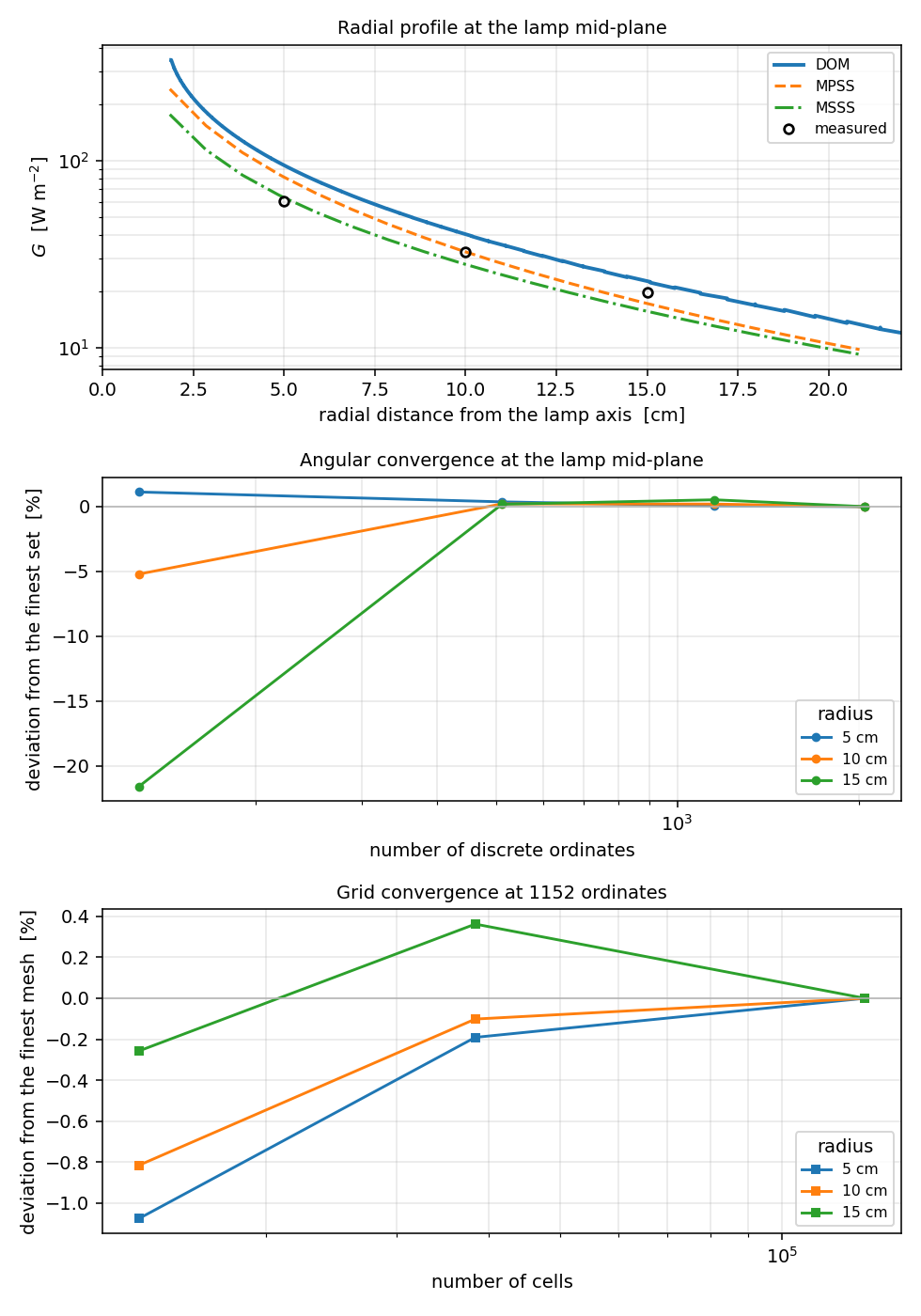
| Range | Change at the last step | |
|---|---|---|
| Discrete directions | 128 → 2,048 | 1.2 % (1,152 → 2,048) |
| Grid cells | 13,440 → 129,600 | 1.1 % |
Going from 128 to 512 directions moves values by up to 64 % — just outside the lamp, 128 directions cannot resolve the solid angle the cylinder subtends. Beyond that it converges monotonically: at most 1.19 % from 512 → 1,152 and 1.18 % from 1,152 → 2,048.
The energy balance closes to 0.00 % in every configuration — the power set as the source leaves the domain exactly. As noted above this is not on its own evidence of accuracy, but taken together with the agreement against the exact solution it means the discretisation is both conservative and accurate.
What this establishes
The solver reproduces the exact answer. With no absorption it agrees with the analytic solution to 1.12 % on average, the symmetry boundaries hold exactly, and it converges in both angle and grid.
The difference between DOM and measurement reported in the model comparison document therefore comes from the model not treating refraction, rather than from the accuracy of the discretisation. Keeping the two separate is what makes it possible to judge how far the results can be trusted.
References
- Modest, M. F. (2013). Radiative Heat Transfer, 3rd ed. Academic Press. — radiance invariance and at a Lambertian surface.