
A free uniform bar changes length but develops no stress when heated uniformly. Preventing the same axial expansion converts the thermal strain into compressive stress. This case checks that thermal strain enters the structural constitutive law correctly and remains distinct from mechanical strain.
What this case verifies
- Reference-temperature and temperature-increment handling
- Isotropic linear thermal expansion
- Conversion of a displacement constraint into reaction force and compressive thermal stress
- The imposed-temperature path into structural analysis
Problem definition
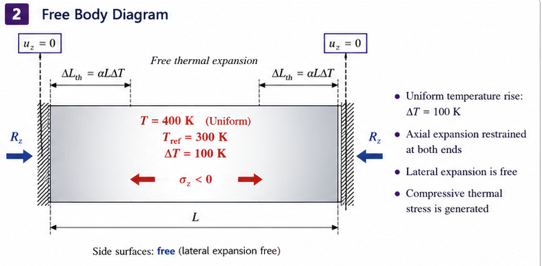
A uniform temperature rise of K is imposed on the entire bar. Both ends are restrained in the axial direction, while lateral roller conditions permit free transverse expansion. The final temperature is uniform at 400 K.
Reference solution
Without restraint, the linear thermal strain would be
The total axial strain is the sum of mechanical and thermal strain:
Full axial restraint requires , giving
The negative sign denotes compression when thermal expansion is prevented. Because transverse expansion is allowed, this is a uniaxially restrained state and the von Mises stress equals .
Results
| Quantity | Theory | FEM | Error |
|---|---|---|---|
| Uniform temperature | 400 K | 400 K | 0.0% |
| von Mises stress | 2.4e8 Pa | 2.4e8 Pa | 0.0% |
Both temperature and thermal stress reproduce the closed-form values exactly. The result demonstrates that reference temperature, expansion coefficient, temperature increment, and structural constraints are combined consistently—not only that ordinary elastic deformation works.
Engineering significance
This is the limiting baseline for restrained piping, shrink fits, motor housings, and supports that cannot expand freely under a temperature change. Real assemblies add finite restraint stiffness and temperature gradients; this case establishes the fully restrained limit before those effects are introduced.
Reference
- Boley, B. A. and Weiner, J. H. Theory of Thermal Stresses — linear thermoelastic constitutive relations.