
This case exercises the basic structural-analysis path in Indux Mechanical using one of the simplest three-dimensional linear-elastic problems. Its spatially uniform, unambiguous closed-form solution isolates the material law, surface loading, constraints, and stress/displacement post-processing from geometric complexity and stress concentrations.
What this case verifies
- Hooke's law for isotropic linear elasticity
- Transfer of a surface traction into a uniform axial stress
- Fixed and free-surface boundary conditions
- Axial elongation and lateral contraction caused by Poisson's effect
- The complete Gmsh → SU2 → Indux Mechanical input, solve, and post-processing pipeline
Problem definition
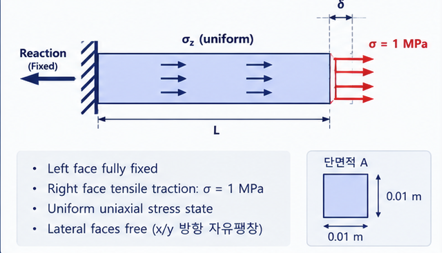
One end of a three-dimensional prismatic bar of length and cross-sectional area is fully fixed. A uniform tensile traction of MPa is applied to the opposite end. Taking the loading direction as , the region sufficiently far from the constrained end approaches a uniform uniaxial stress state by Saint-Venant's principle.
Reference solution
For a uniform bar subjected to axial force , the stress and free-end displacement are
where is Young's modulus. Poisson's ratio determines the lateral contraction:
For a uniaxial stress state, the von Mises equivalent stress is also . The same problem therefore checks the stress, axial-displacement, and lateral-displacement paths independently.
Results

| Quantity | Theory | FEM | Error |
|---|---|---|---|
| Mean von Mises stress | 1.000e6 Pa | 9.95e5 Pa | −0.50% |
| Axial displacement | 5.00e-7 m | 4.98e-7 m | −0.40% |
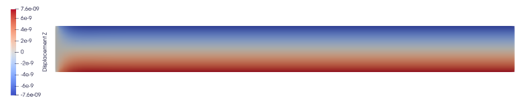
| Lateral displacement | ±7.50e-9 m | ±7.63e-9 m | +1.73% |
The primary quantities—the mean stress and axial displacement—agree with theory to within 1%. The lateral displacement is only a few nanometers, so a small absolute difference produces a larger relative error; it is treated as a secondary check. An interior average is used instead of the peak stress at the constrained-end corners to exclude local boundary-condition singularities from the acceptance decision.
Engineering significance
The result establishes a baseline for tensile members, rods, and bolts under axial load. It is also a useful minimal case for diagnosing units, load direction, material properties, mesh input, or post-processing before investigating a more complex failed verification.
Reference
- Beer, F. P. et al. Mechanics of Materials — axial loading, Hooke's law, and Poisson's effect.