
Every material point in a rotating body is subjected to a radial centrifugal body force. Unlike a simple surface-load case, this problem verifies that the load derived from density and angular velocity is integrated correctly over every element and produces the expected axisymmetric stress and displacement fields.
What this case verifies
- Centrifugal body force computed from density and angular velocity
- Radial and hoop stresses under plane stress
- Quarter-model symmetry and a traction-free outer rim
- Regularity at the rotation axis and radial-displacement post-processing
Problem definition
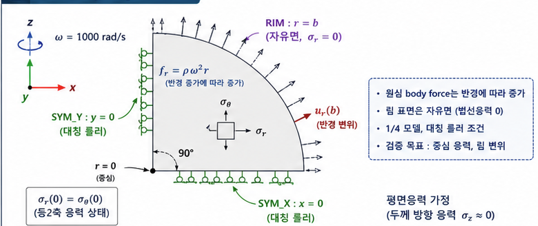
A uniform solid disk of outer radius rotates at rad/s. The thin disk is modeled under plane stress, roller symmetry is imposed on the cut faces of the quarter model, and the outer rim is free.
Reference solution
For a uniform isotropic elastic disk,
The radial stress satisfies the free-rim condition . At the center, , giving an equibiaxial stress state. The radial displacement is
and reduces at the rim to . Because every response quantity scales with , the case is sensitive to angular-velocity units and conversion errors.
Results
| Quantity | Theory | FEM | Error |
|---|---|---|---|
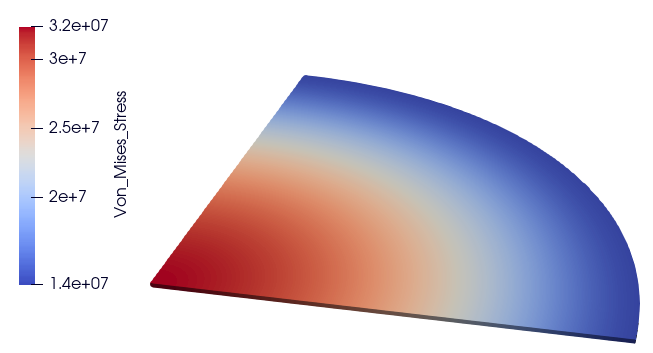
| Center | 3.238e7 Pa | 3.236e7 Pa | <0.3% |
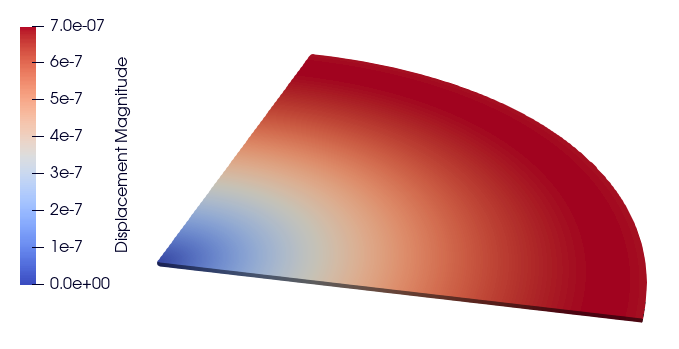
| Rim displacement | 6.869e-7 m | 6.951e-7 m | +1.2% |
The von Mises stress profile agrees with theory to within 0.3% over the full radius. The rim displacement differs by 1.2%, slightly above the nominal 1% criterion, while the full stress profile confirms stable reproduction of the body force and axisymmetric stress field.
Engineering significance
The case is directly relevant to motor rotors, flywheels, impellers, and rotating disks. Real components add bores, material anisotropy, contact, and imbalance; this result provides the clean baseline before those effects are introduced.
Reference
- Young, W. C. and Budynas, R. G. Roark's Formulas for Stress and Strain — elastic rotating-disk solutions.