
A plate containing a circular hole is a canonical example of finite elastic stress concentration caused by a geometric discontinuity. The solution changes rapidly in space while the hole boundary remains smooth, making it well suited to testing how accurately the elements capture a stress gradient and converge under local mesh refinement.
What this case verifies
- The traction-free condition on a curved free surface
- Plane-stress constitutive behavior and quarter-model symmetry
- Stress-component transformation and circumferential post-processing
- Local stress concentration and monotonic convergence with mesh refinement
Problem definition
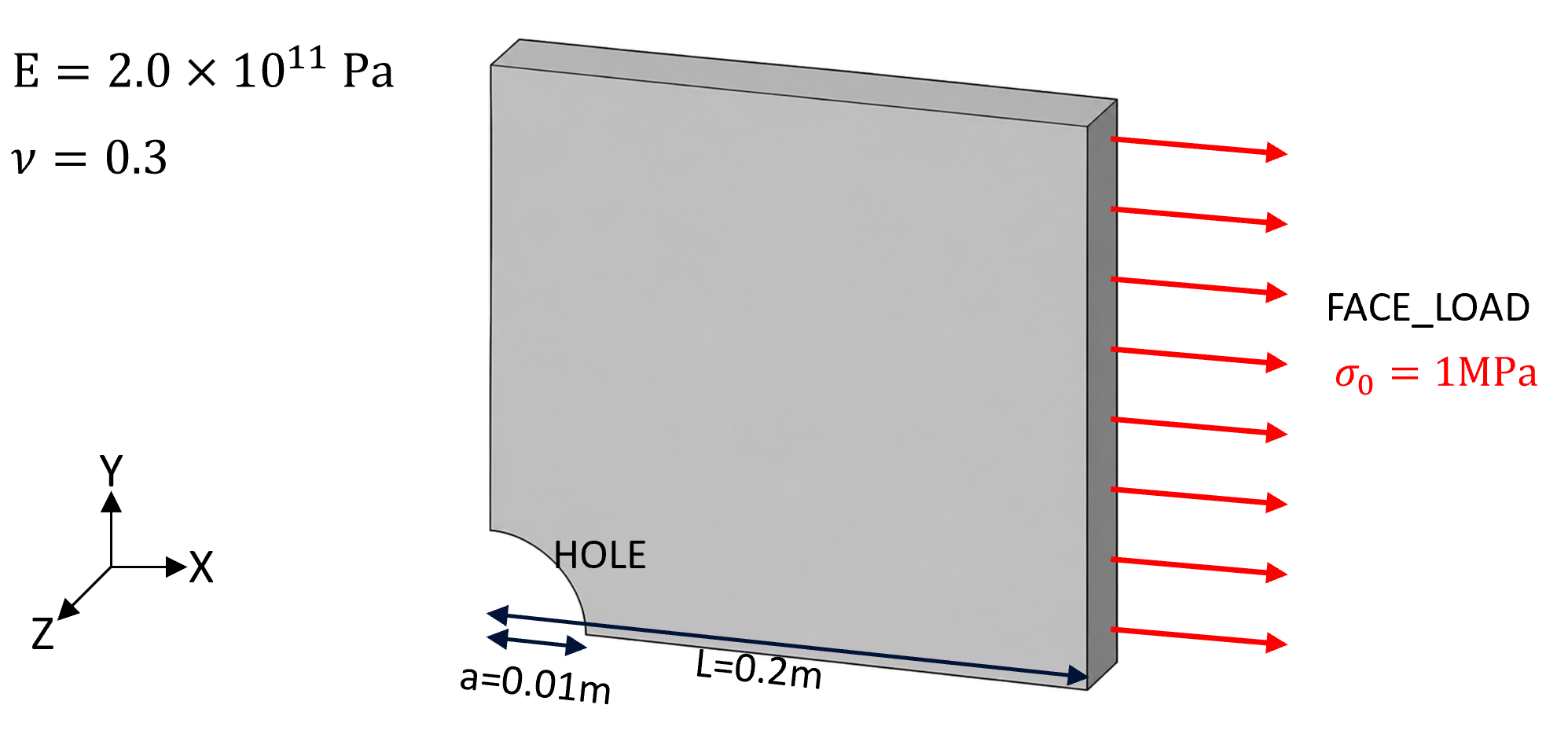
A circular hole of radius is placed in a plate wide enough to approximate an infinite domain, with remote uniaxial tension . Load and geometric symmetry reduce the model to one quarter, and plane stress is assumed.
Reference solution
At the hole boundary , Kirsch's solution gives zero radial and shear traction:
The circumferential stress is
When is measured from the loading axis, the maximum at is . Thus the elastic stress concentration factor is
Unlike a crack-tip singularity, this is a finite concentration around a smooth boundary, so numerical convergence toward an exact value can be judged directly.
Results
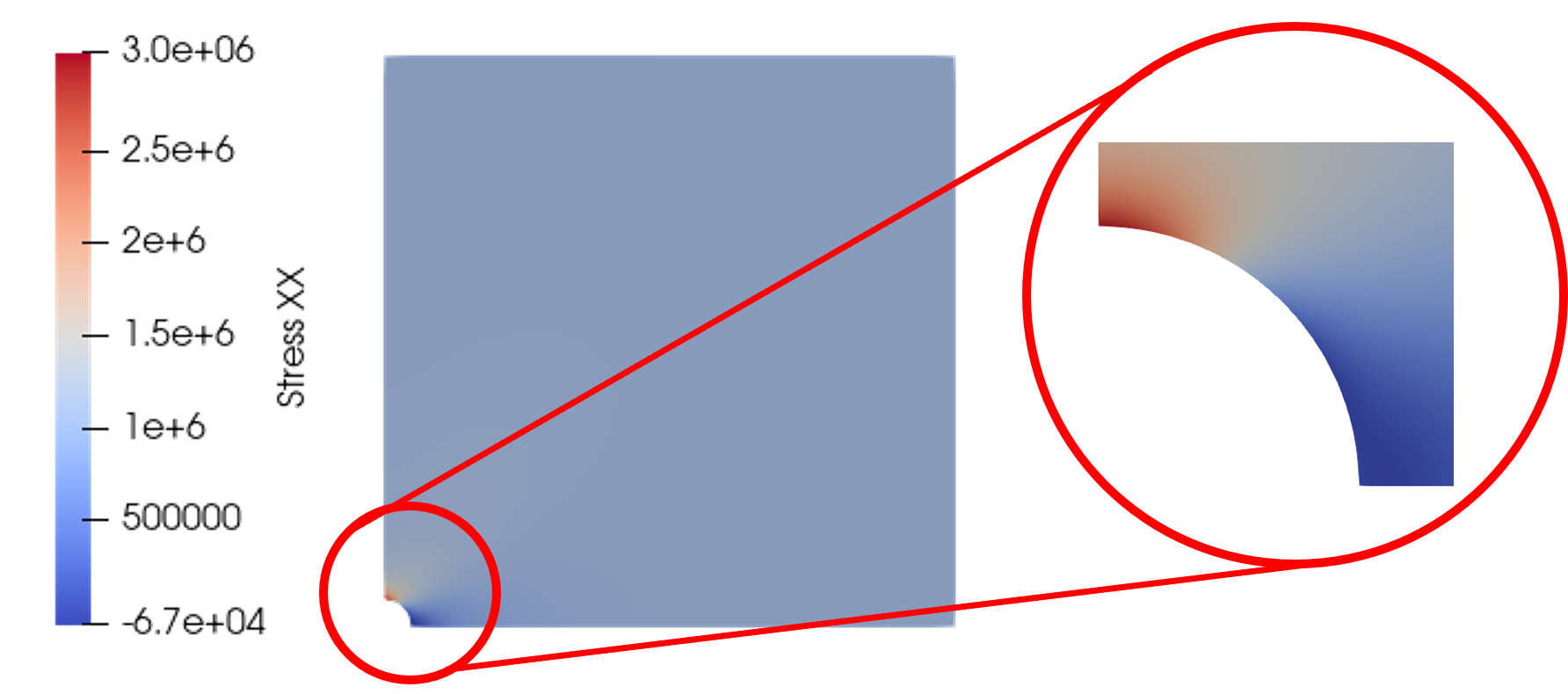
| Quantity | Theory | FEM | Error |
|---|---|---|---|
| Stress concentration factor | 3.00 | 2.92 → 2.99 | −2.7% → −0.3% |
The error decreases monotonically from 12.7% to 4.3% to 0.34% under refinement. A coarse mesh initially under-resolves the local maximum, while refinement around the hole drives the result toward the exact value of 3.
Engineering significance
This verification is directly relevant to bolt holes, coolant passages, and housing openings. It also shows why a reported peak stress in a design should be accompanied by a local mesh-sensitivity check.
Reference
- MIT OpenCourseWare, Stresses Around a Circular Hole — Kirsch's solution and the result.