
A thick-walled cylinder cannot be represented by the membrane-stress approximation used for thin shells; its stress and displacement vary through the wall. This case simultaneously exercises curved pressure loading, cylindrical stress distributions, symmetry conditions, and the plane-strain constitutive relation.
What this case verifies
- Sign and magnitude of pressure traction normal to the inner wall
- Radial and hoop stress variation through the thickness
- The plane-strain condition for a long cylinder
- Roller constraints on a quarter-symmetry model
- Mesh-convergence order of a smooth displacement quantity
Problem definition
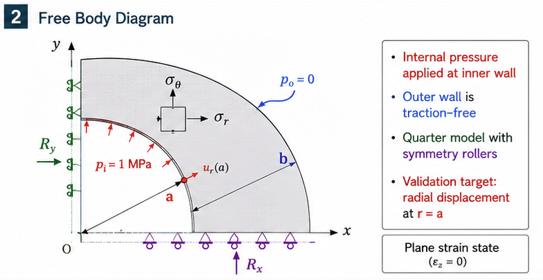
The cylinder has inner radius m and outer radius m. Internal pressure is applied, the external pressure is zero, and roller conditions are imposed on the two cut faces of the quarter model. The model uses plane strain to represent a sufficiently long, axially restrained cylinder.
Reference solution
The axisymmetric Lamé stress field has the form
For internal pressure only,
Using tension-positive signs, and , exactly satisfying the two radial traction conditions. Under plane strain, the radial displacement is
The pressure/constraint junction can generate corner singularities. The smooth inner-wall displacement is therefore used as the primary acceptance quantity instead of a single local peak stress.
Results
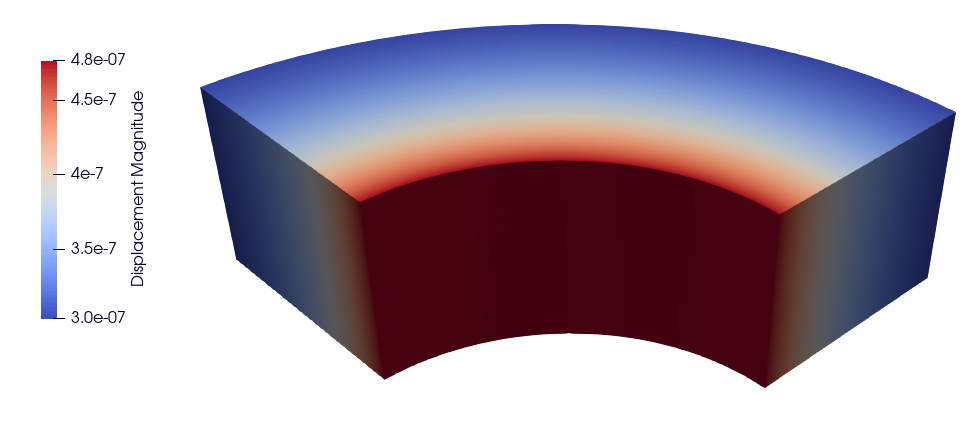
| Quantity | Theory | FEM | Error |
|---|---|---|---|
| 4.767e-7 m | 4.755e-7 m | −0.25% |
The inner-wall displacement agrees with theory to within 0.25%. Under mesh refinement, the observed order is approximately 1.8–2, consistent with the expected second-order convergence of the smooth displacement field. Convergence at the expected rate is stronger implementation evidence than a small error on only one mesh.
Engineering significance
This case is a baseline for pressure vessels, hydraulic cylinders, bearing or bushing fits, and rotor sleeves, where through-thickness stress gradients matter and the inner and outer surfaces must be evaluated separately.
Reference
- MIT OpenCourseWare, Introduction to Structural Mechanics — “Thick-Walled Cylinder under Radial Pressure.”