
A convecting fin combines conduction inside a solid with convection from its surface to the surrounding fluid. This case checks that fixed-temperature, adiabatic, and convective boundary conditions are assembled consistently with the conduction constitutive law and the overall energy balance.
What this case verifies
- Coupling of Fourier conduction and Newton's law of cooling
- Fixed-temperature base, convective sides, and adiabatic tip
- Surface integration of the convection coefficient and exposed perimeter
- The full axial temperature profile, not only a single nodal value
Problem definition
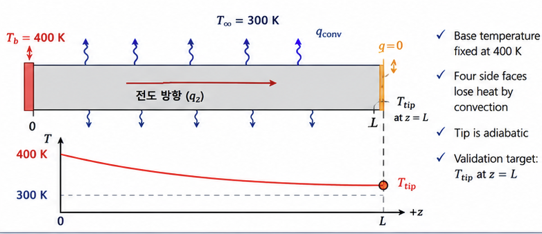
The straight fin has constant cross-sectional area and perimeter . Its base is held at K. The four side faces use W/m²K and K, while the tip has zero heat flux. Thermal conductivity and the convection coefficient are constant, and radiation is neglected.
Reference solution
Defining excess temperature as gives the steady one-dimensional fin equation
Applying and yields
The adiabatic-tip temperature is therefore
Neither a correct conduction implementation nor a correct convection implementation alone is sufficient to reproduce this solution; the test exercises both physics contributions and their boundary integration.
Results
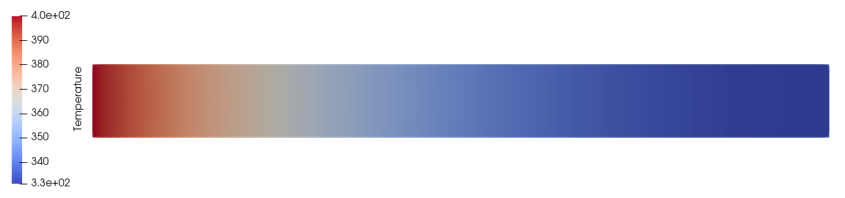
| Quantity | Theory | FEM | Error |
|---|---|---|---|
| Tip temperature | 331.03 K | 331.03 K | ~0% |
The tip temperature is effectively exact, and the entire axial profile agrees with the hyperbolic-cosine solution to within 0.1%. Agreement over the profile demonstrates that the result is not a coincidental match at one point.
Engineering significance
The case underpins thermal analysis of motor housings, cooling fins, and heat sinks. Real natural or forced convection can have a spatially varying ; this constant-coefficient case deliberately isolates the thermal solver before that modeling uncertainty is introduced.
Reference
- MIT Unified Engineering, Heat Transfer From a Fin — adiabatic-tip temperature distribution.