
Accurate thermal and structural solvers are not sufficient by themselves for a reliable coupled analysis. The nodal or cell temperatures must be transferred without omission, reordering, or unit errors and combined with the correct structural reference temperature. This case isolates and verifies that interface.
What this case verifies
- Storage and transfer of a steady thermal result into the structural step
- Correspondence of thermal and structural degrees of freedom or mesh indices
- Evaluation of transferred temperature relative to the structural reference temperature
- Thermal strain and stress generation in one-way Heat → FEA coupling
- Equivalence of computed-and-transferred and directly imposed temperature fields
Problem definition
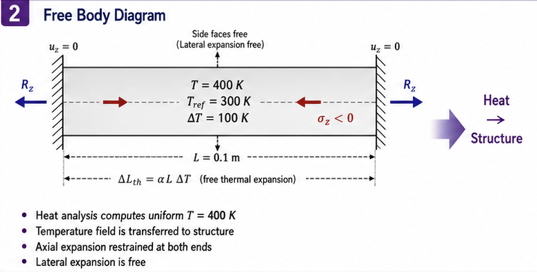
First, one face is held at 400 K and every other face is adiabatic in a steady thermal solve. With no internal source and no heat-loss boundary, the entire domain reaches the uniform solution of 400 K. That field is then passed to a structural solve of the axially restrained bar.
Reference solution and equivalence
The steady thermal equation is
and the stated boundary conditions give K. The structural step constructs the isotropic thermal-strain tensor from the transferred temperature:
Stress follows from the mechanical part of the total strain:
The result must therefore be identical to the Thermal Stress Bar case, in which 400 K is imposed directly in the structural analysis. This equivalence is a metamorphic test of the data-transfer path, independent of the separate accuracy checks for either solver.
Results
| Quantity | Theory | FEM | Error |
|---|---|---|---|
| Thermal solution | 400 K, uniform | 400 K | exact |
| Structural | 2.4e8 Pa | 2.4e8 Pa | ~0% |
The result is identical to the directly imposed-temperature case. This confirms that the computed thermal field is transferred correctly and generates the same thermal strain and structural stress.
Engineering significance
This is the smallest reference problem for the path from motor loss → temperature field → thermal expansion → stress and deformation. It verifies the coupling interface before spatially varying temperatures and material-dependent expansion coefficients are introduced in a production model.
Reference
- Boley, B. A. and Weiner, J. H. Theory of Thermal Stresses — thermal strain and linear thermoelasticity.