
Steady one-dimensional conduction is the basic patch test for a thermal solver. In a uniform material with no internal heat generation or time dependence, temperature must be exactly linear. Even small errors in matrix assembly or Dirichlet boundary handling are therefore easy to detect.
What this case verifies
- The steady heat-conduction equation and Fourier's law
- Fixed-temperature boundary conditions at both ends
- Exact reproduction of a linear temperature field
- Minimum, maximum, and average-temperature post-processing
Problem definition
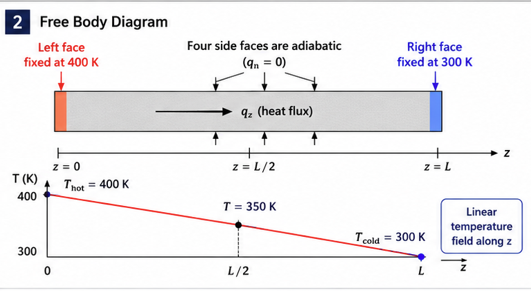
The ends of a uniform bar of length are fixed at K and K. The lateral surfaces are adiabatic, thermal conductivity is constant, and there is no volumetric heat source.
Reference solution
Under steady, constant-property, source-free conditions, the one-dimensional equation is
With constant and area , this becomes and gives
Fourier's law gives a spatially constant heat-transfer rate:
The midpoint temperature at is exactly 350 K, as is the volume average for this linear field.
Results
| Quantity | Theory | FEM | Error |
|---|---|---|---|
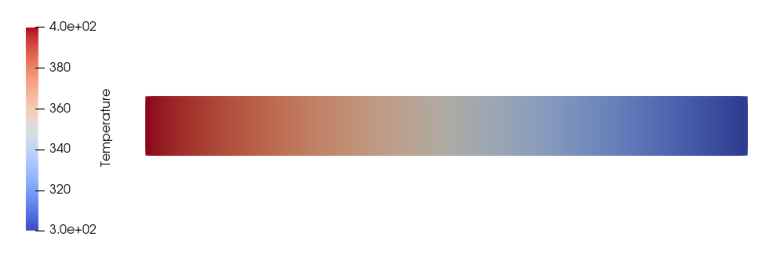
| / / | 300 / 400 / 350 K | 300 / 400 / 350 K | exact |
The minimum, maximum, and average temperatures reproduce the exact values. Because the exact solution lies inside the interpolation space of linear elements, a correct implementation should reproduce this field independently of mesh size.
Engineering significance
This is the baseline for through-thickness heat flow in walls and plates and for later multi-layer thermal resistance problems. It is also a minimal diagnostic for checking units, conductivity, temperature constraints, and heat-flux sign conventions.